
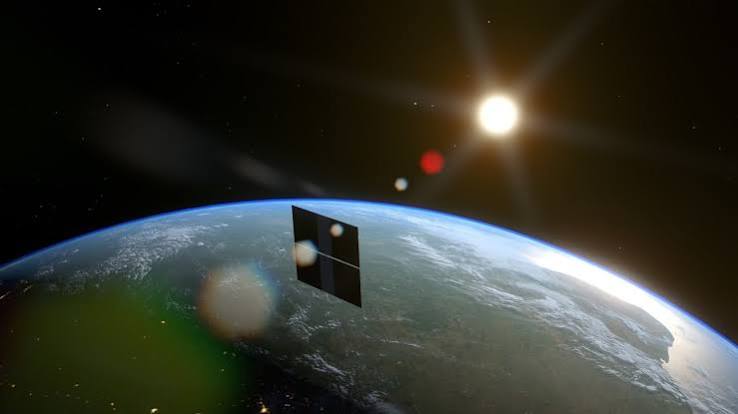

Artificial intelligence has a new place to work: orbit.
On October 30, 2026, Google announced that its Project Suncatcher prototype satellite had successfully generated its first AI response in space. The experiment used Google’s Gemma 4 open model running on a Tensor Processing Unit, or TPU, aboard a spacecraft built in partnership with Planet Labs.
The prompt was simple: write a haiku about being in space.
The satellite processed the request and transmitted its answer back to Earth through a ground station in Svalbard, Norway. The poem was short, but the engineering behind it was significant. The system had received a command, run an AI workload on an orbital processor, and returned the result successfully.
It was a first step toward a much bigger ambition: exploring whether the infrastructure used to power AI could eventually operate beyond Earth’s atmosphere.
Google’s idea is called Project Suncatcher, a long-term research effort investigating solar-powered satellites equipped with AI accelerators and connected through high-speed optical communications.
The company is not claiming that enormous orbital data centers are ready to replace terrestrial facilities. Instead, it is testing the components and operating conditions that would be needed to make such a system possible.
That distinction matters. Running an AI model on one satellite is a demonstration. Building a dependable network of satellites that can collectively perform demanding computing tasks is an entirely different challenge.
Why Put AI Data Centers in Space?
Today’s AI systems depend on data centers filled with processors, memory, networking equipment, cooling systems, and power infrastructure. As AI workloads grow, operators must find ways to supply more electricity, manage heat, and expand computing capacity.
Project Suncatcher explores whether space could eventually offer an alternative location for some of that infrastructure.
The most obvious attraction is solar energy.
In a carefully selected orbit, satellites can receive sunlight for much longer periods than solar installations on Earth’s surface, where night, clouds, weather, and atmospheric conditions affect energy collection. Google has argued that solar panels in suitable orbits could generate substantially more energy per unit area than comparable panels on Earth.
A network operating in a sun-synchronous orbit could be designed to receive near-continuous sunlight, reducing reliance on large onboard batteries during normal operation.
Space also offers a different physical environment. There is no weather to interrupt a satellite’s exposure to sunlight, and orbital infrastructure would not need to occupy valuable land near population centers.
Those advantages could become attractive if launch costs continue falling and solar-powered computing systems become more efficient.
However, sunlight is not free electricity. Solar panels, power electronics, batteries, processors, radiators, communications systems, and protective structures all add mass and complexity. Every kilogram must be launched, and every component must operate reliably in a harsh environment that is difficult and expensive to repair.
The real question is not whether solar-powered AI can work in orbit. Google has already demonstrated a small version of that idea.
The question is whether an orbital computing network can deliver useful computing capacity reliably and economically at a meaningful scale.
What Project Suncatcher Has Actually Demonstrated
Google’s prototype launched on October 1, 2026, aboard a SpaceX rideshare mission. Built with Planet, the spacecraft carries four Google TPUs and solar-powered systems intended to support experimental AI workloads.
After commissioning its systems, the satellite completed early machine-learning tests. The successful haiku experiment then demonstrated that an onboard model could receive a prompt, generate a response, and transmit the output to a ground station.
That is a meaningful engineering milestone because it connects several systems into one working process.
The satellite must maintain power, operate its processor, run the model, manage the resulting data, establish a communication link, and send the output successfully during an available ground-station pass.
Google also tested additional prompts, including requests related to the satellite’s technical status.
Yet the prototype remains a research platform, not a miniature version of a commercial AI cloud. A successful response does not establish that the satellite can operate continuously at high computing utilization, train large models in orbit, or serve millions of users.
The next experiments will examine how the TPUs behave under actual orbital conditions, particularly temperature changes and radiation exposure. Google has also identified a two-satellite demonstration planned for 2027 as a major next step.
That experiment would begin addressing one of the most difficult questions in the project: can multiple satellites communicate well enough to function as a coordinated computing system?
Challenge One: Keeping the Hardware Alive
Space is an unforgiving place for electronics.
During launch, spacecraft experience intense vibration and acceleration. Once in orbit, they face radiation from the Sun and other sources, repeated thermal changes, and an environment where equipment cannot be maintained as easily as a machine in a terrestrial data center.
Radiation is particularly important for AI hardware.
High-energy particles can interfere with electronic components and cause errors in memory or computation. A bit flip, for example, changes a stored binary value from zero to one or vice versa. Such errors may be temporary, recoverable, or serious enough to corrupt data or interrupt a workload.
For ordinary consumer electronics, a rare error may be manageable. For a large computing network, reliability becomes more complicated because many processors must continue working together over extended periods.
Google has conducted ground-based radiation testing on its Trillium TPU hardware, including experiments using proton beams. Those results offered encouraging early evidence, but laboratory testing cannot reproduce every condition a spacecraft will encounter over years in orbit.
The company now needs to collect real flight data.
Engineers will need to measure how often errors occur, whether they can be detected automatically, how systems recover, and whether the hardware’s performance changes over time. They must also determine how much shielding is practical without adding so much mass that launch and structural costs become prohibitive.
A future orbital data center would need more than processors that work when switched on. It would need a dependable architecture that can detect failures, recover from them, and continue delivering results.
Challenge Two: Cooling Computers in a Vacuum
One of the biggest misconceptions about space is that the cold environment makes cooling computers easy.
In reality, removing heat from electronics in orbit is a major engineering problem.
AI accelerators consume electrical power and convert a substantial portion of it into heat. On Earth, data centers use air circulation, liquid cooling, heat exchangers, and other systems to move that heat away from processors.
Space offers no surrounding air for conventional fans or air-cooled heat sinks to transfer heat into.
Instead, spacecraft must move heat through materials and thermal systems before radiating it into space. Heat pipes can transport energy away from processors, while radiators release that energy as infrared radiation.
The design becomes especially demanding when high-performance processors concentrate substantial power in a small area.
A radiator must have enough surface area to release the heat generated by the equipment. Its effectiveness also depends on factors such as its temperature, orientation, exposure to sunlight, and the heat arriving from nearby spacecraft components.
The system must maintain safe operating temperatures while experiencing changing illumination and orbital conditions.
Google says its research includes testing combinations of heat pipes and radiators in thermal-vacuum chambers before evaluating the system in orbit.
For a large orbital computing network, cooling cannot be treated as an afterthought. It will affect satellite size, mass, power requirements, reliability, and ultimately the amount of computing capacity that can be deployed economically.
Challenge Three: Making Satellites Work Together
A single satellite can run a relatively self-contained AI task. A data center, however, derives much of its power from connecting many processors and distributing workloads between them.
Google’s long-term vision involves clusters of satellites equipped with AI accelerators and linked by laser communications.
Optical links can carry large amounts of data, but maintaining a high-speed connection between moving spacecraft requires extraordinary precision. The satellites must know their positions, track their neighbors, align their optical terminals, and maintain the connection as their relative positions change.
The challenge is not simply sending a message between two satellites. It is moving enough data quickly and reliably to support demanding AI workloads.
Google’s 2025 research paper described a possible system using tightly clustered satellites and optical links designed for extremely high bandwidth. The company’s early analysis explored whether such connections could eventually support the communication needs of a large machine-learning system.
The proposed network is still a design vision, not a demonstrated orbital data center.
The planned two-satellite test in 2027 is therefore important. It should help establish whether the optical communication approach works under real flight conditions and whether multiple satellites can exchange data reliably while moving in orbit.
If that works, researchers will still need to test larger clusters, coordinate workloads, recover from link interruptions, and understand how communication delays affect performance.
A system with many processors is only as useful as its ability to keep those processors connected and productive.
Challenge Four: Power, Launch Costs, and the Economics
Even if the technical problems can be solved, orbital computing must justify its cost.
The prototype’s power supply illustrates the gap between demonstrating an AI response and operating a high-capacity data center. Reporting on the experiment indicates that the satellite can generate up to roughly one kilowatt of electrical power, while the power demands of its TPU hardware limit how long a processor can run at a time.
That is enough for carefully selected experiments, but it is far from the power capacity of a large terrestrial data center.
Scaling the concept would require substantially more solar generation, power management, thermal control, and computing hardware. Engineers would also need to account for launch expenses, communications infrastructure, spacecraft replacement, and the cost of handling failures.
There is a potential advantage: solar energy in a suitable orbit can be available for extended periods. But an orbital system must still convert that energy into usable electricity, route it to processors, and remove the resulting heat.
Its total cost must be compared with terrestrial facilities, which already benefit from mature supply chains, established maintenance practices, and access to electrical grids and cooling infrastructure.
Google’s long-term research has explored the possibility that falling launch costs could improve the economics of space-based computing. That remains a projection, not a guarantee. Launch prices, hardware lifetimes, system efficiency, and the cost of orbital servicing will all influence whether the concept becomes commercially practical.
Space-based AI might eventually serve specialized purposes even if it never becomes cheaper than every Earth-based data center. The important question is which workloads benefit enough from orbital operation to justify the additional complexity.
What Scientists Need to Prove Next
The next stage of Project Suncatcher should move beyond proof of basic operation and toward measurable evidence of sustained performance.
Several questions remain:
- Hardware reliability: Can the processors and memory systems operate for years in orbit while maintaining acceptable error rates?
- Thermal performance: Can the cooling system remove heat safely during realistic operating cycles without excessive mass or power consumption?
- Communication bandwidth: Can two or more satellites maintain fast, stable optical connections while moving relative to one another?
- Computing performance: Can orbital systems run useful workloads efficiently, including the data transfers and coordination required by larger AI models?
- Fault recovery: Can the system detect errors, restore failed components or workloads, and continue operating when a satellite or connection becomes unavailable?
- Economic viability: Can the total cost of launching, powering, operating, and eventually replacing the satellites compete with terrestrial alternatives for specific workloads?
Researchers will also need to distinguish between inference and training. Inference means using an existing model to generate an answer or prediction. Training involves adjusting a model’s parameters using large amounts of data and can demand substantially more computing and communication.
The haiku demonstration established an early inference capability. It did not demonstrate that a large AI model can be trained in orbit at commercial scale.
That is why the coming tests matter more than the novelty of an AI-generated poem. They will help determine whether the concept can progress from an interesting experiment to a reliable computing architecture.
A New Frontier, Not an Immediate Replacement
Project Suncatcher offers a compelling vision: solar-powered satellites that process information above Earth, communicate with one another, and potentially support future AI workloads without relying entirely on ground-based infrastructure.
If successful, space-based computing could eventually become useful for certain scientific, communications, or specialized computing applications. It might also encourage new approaches to designing energy systems, cooling infrastructure, and networks of distributed processors.
But the distance between a working prototype and a commercial orbital data center is enormous.
The technology must survive the environment, manage heat, move data at high speed, and demonstrate dependable operation at a cost that makes sense. Those requirements are difficult individually and more difficult when combined.
For now, Project Suncatcher is best understood as a research program testing whether AI infrastructure can operate beyond Earth in a scalable way.
The satellite’s first response was a small message from a machine in orbit. Its real significance lies in what engineers must do next: prove that the system can keep working, connect to other systems, and deliver something valuable enough to justify the journey.
The future of AI may not be limited to Earth. But before space becomes a practical home for data centers, scientists will need to show that the technology can do far more than write a poem.
References
- Google Research — Google receives its first response from the Project Suncatcher prototype satellite
- Google Research — Behind Project Suncatcher: Google’s research into AI infrastructure in space
- Google Research — Exploring a space-based, scalable AI infrastructure system design
- TechCrunch — Google’s first data center satellite is online and writing poetry
- Aviation Week — Google’s Suncatcher satellite sends AI-generated response

Leave a Reply